Simple Tech Additions That'll Increase Revenue
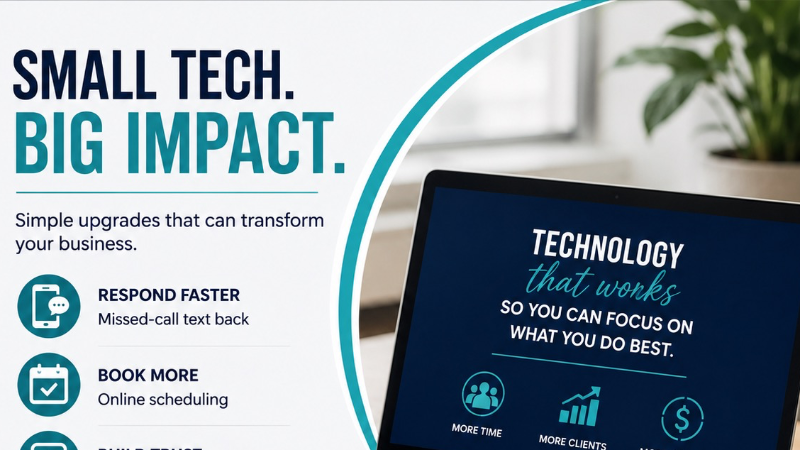
When small business owners hear words like “technology,” “automation,” or “AI,” it can sound expensive, complicated, and like one more thing they have to learn.
But here’s the good news: you don’t need a massive technology overhaul to make a big difference in your business.
Sometimes the smartest improvements are the smallest ones.
A few affordable tools and simple automations can help you respond faster, stay organized, improve your customer experience, and stop letting opportunities quietly slip through the cracks.
Here are a few places I’d start.
1. Missed-Call Text Back
You’re working with a customer, driving, in a meeting, or simply taking a much-needed lunch break when your phone rings.
You miss the call.
The problem? That potential customer may immediately call the next business.
A missed-call text-back system automatically sends the caller a friendly text letting them know you received their call.
Something as simple as:
“Hi! Sorry we missed your call. How can we help?”
That tiny addition keeps the conversation alive until you can respond personally.
You’re not replacing human interaction. You’re simply making sure the customer knows, “We see you, and we’re going to help you.”
2. Online Appointment Scheduling
How much time do you spend going back and forth trying to schedule appointments?
“Does Tuesday work?”
“No, how about Wednesday?”
“What time Wednesday?”
There’s an easier way.
An online calendar lets customers see your actual availability and select a time that works for both of you.
Add automatic confirmations and reminders, and you’ve created a much smoother process.
This can mean:
- Less phone tag
- Fewer scheduling emails
- Fewer forgotten appointments
- More convenience for customers
- More time back in your day
Small change. Huge sanity saver.
3. Automated Review Requests
Happy customers are one of your best marketing assets, but most businesses simply forget to ask them for reviews.
Make it automatic.
After a service is completed, customers can receive a short text or email thanking them for their business and providing a direct link to leave a review.
No awkward asking.
No remembering to send the link later.
Just a simple system working quietly in the background.
Over time, those reviews can strengthen your online reputation, increase trust, and help potential customers feel more confident choosing your business.
4. Website Chat
Sometimes customers visit your website with one simple question standing between them and contacting you.
Do you service my area?
How do I schedule?
Do you offer this particular service?
Website chat gives visitors another convenient way to get answers.
And today, chat technology can do much more than display a little message bubble.
Depending on your business, it can help:
- Answer frequently asked questions
- Collect contact information
- Qualify inquiries
- Direct visitors to services
- Schedule appointments
- Capture after-hours leads
You don’t need to turn your website into a robot. The goal is simply to make getting help easier.
5. Digital Business Cards
A digital business card is one of my favorite low-cost upgrades because it makes networking and referrals ridiculously easy.
Instead of handing someone a paper card and hoping they keep it, let them scan a QR code or tap a link.
Now they can instantly access your:
- Contact information
- Website
- Booking calendar
- Services
- Social media
- Reviews
- Portfolio
They can also share your information with someone else in seconds.
For service businesses that grow through networking and word-of-mouth, that convenience can create opportunities long after the original conversation.
6. Simple Email and Text Follow-Up
Not every prospect is ready to buy the first time they contact you.
And that’s okay.
The mistake is assuming “not right now” means “never.”
A simple follow-up system can keep your business connected to prospects without requiring you to remember who needs another phone call next Thursday.
Follow-up might include:
- Appointment reminders
- Estimate follow-ups
- Helpful tips
- Frequently asked questions
- Customer success stories
- Check-in messages
- Seasonal reminders
The goal isn’t to bombard people with messages.
It’s to stay visible until they’re ready.
7. Online Forms That Actually Go Somewhere
Raise your hand if your website has a “Contact Us” form that sends an email…and that’s about it.
We can do better, boo.
A modern form can automatically organize the information someone submits, create a new contact in your system, notify the right person, send the prospect a confirmation, and trigger the appropriate next step.
For example:
Customer submits request → information is saved → your team is notified → customer receives confirmation → follow-up begins.
Nobody has to copy and paste anything.
That’s automation in its simplest form.
8. QR Codes
QR codes are inexpensive, easy to use, and incredibly versatile.
They can connect your offline marketing directly to your online presence.
Put them on:
- Flyers
- Brochures
- Business cards
- Signs
- Vehicles
- Direct mail
- Event displays
- Receipts
- Printed estimates
A QR code could take someone directly to your website, digital business card, appointment calendar, review page, special offer, or contact form.
Instead of telling people where to go, take them there.
9. Automated Appointment Reminders
No-shows cost money.
A customer may genuinely intend to show up and simply forget.
Automated reminders can send a text or email before an appointment without you or your staff having to remember.
For businesses that depend on consultations, estimates, service appointments, or scheduled meetings, this one little system can protect valuable time on your calendar.
10. A Better Website Call-to-Action
This one barely feels technical, but it can make a noticeable difference.
Look at your website and ask yourself:
Is it completely obvious what I want someone to do next?
If not, fix that.
Buttons such as:
Schedule a Consultation
Request an Estimate
Call Now
Get Started
Ask a Question
should be easy to find, especially on a mobile phone.
Don't make interested customers hunt for a way to become customers.
Technology Should Make Business Simpler, Not More Complicated
This is where small businesses sometimes get technology wrong.
The goal isn’t to add every shiny new tool available.
More technology does not automatically mean a better business.
Start by looking for friction.
Where are customers waiting?
Where are leads disappearing?
What are you constantly doing manually?
What does your team forget?
What questions do customers ask repeatedly?
Where are you wasting time?
That’s where technology becomes useful.
You may discover that you don't need a $20,000 system.
You need a missed-call text.
An automated reminder.
A digital business card.
A better contact form.
A QR code.
A review request.
Or one simple follow-up sequence.
Those aren't flashy changes, but they solve real problems.
And that's what good technology should do.
Start Small. Solve Something Real.
Small businesses don’t need technology for technology’s sake. They need practical solutions that help them operate better and create a better experience for the people they serve. That practical, profitable approach is also central to how I think about technology for small businesses.
Choose one area of your business that frustrates you or your customers.
Fix that first.
Then move to the next.
Over time, those small improvements begin working together. Your response times improve. Your follow-up gets stronger. Customers have an easier experience. Your team spends less time doing repetitive work. And you have more room to focus on actually growing the business.
You don’t have to become a tech expert.
You just need technology that understands its assignment.
Small upgrades can save time. Small systems can prevent lost opportunities. And the right technology, used in the right places, can make a very big impact.